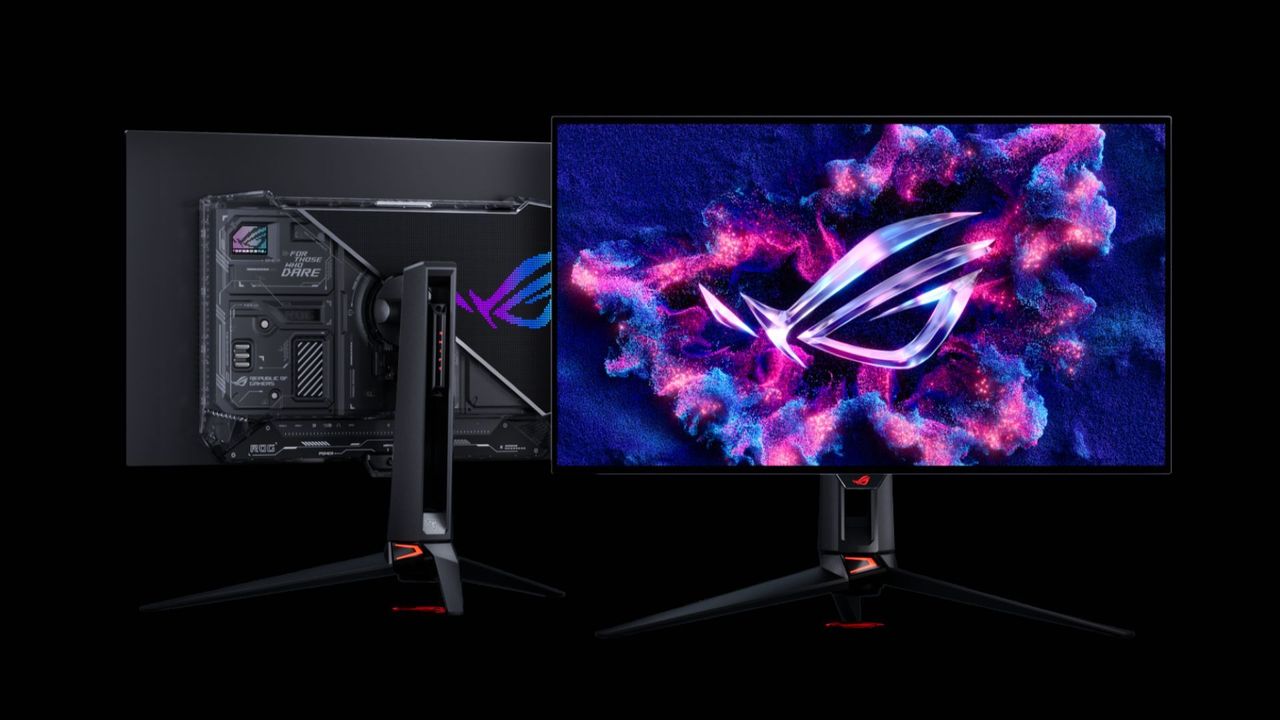
The OLED gaming monitor tech announcements are coming thick and fast at Computex this year. One intriguing new monitor has been outed by Asus featuring a new WOLED panel from LG that we’ve not seen before.
The big news is that the Asus ROG Swift PG32UCWM features RGB-stripe technology. In other words, the panel’s subpixel structure is composed of conventional red, green and blue vertical subpixels in that order.
Until recently, all OLED gaming monitors had panels with various weird and wonderful subpixel structures. LG’s panels had an extra white subpixel to boost peak brightness. Samsung used a triangular layout, albeit with the standard RGB colours.
These non-standard subpixel layouts cause various issues. So, the ideal solution is an absolutely standard RGB-stripe structure. And that’s what the Asus ROG Swift PG32UCWM’s new LG WOLED panel offers.
Note that the “W” in LG’s WOLED branding doesn’t refer to a white subpixel, but the white colour of the base emissive OLED material, which is then passed through red, green and blue filters for each subpixel, respectively.
Anywho, the ROG Swift PG32UCWM is, as I said, a 32-inch 4K model. It runs at 240 Hz at 4K and offers an alternative 1080p mode at 480 Hz. It also sports VESA DisplayHDR True Black 400 certification. And that’s where things get a bit tricky.
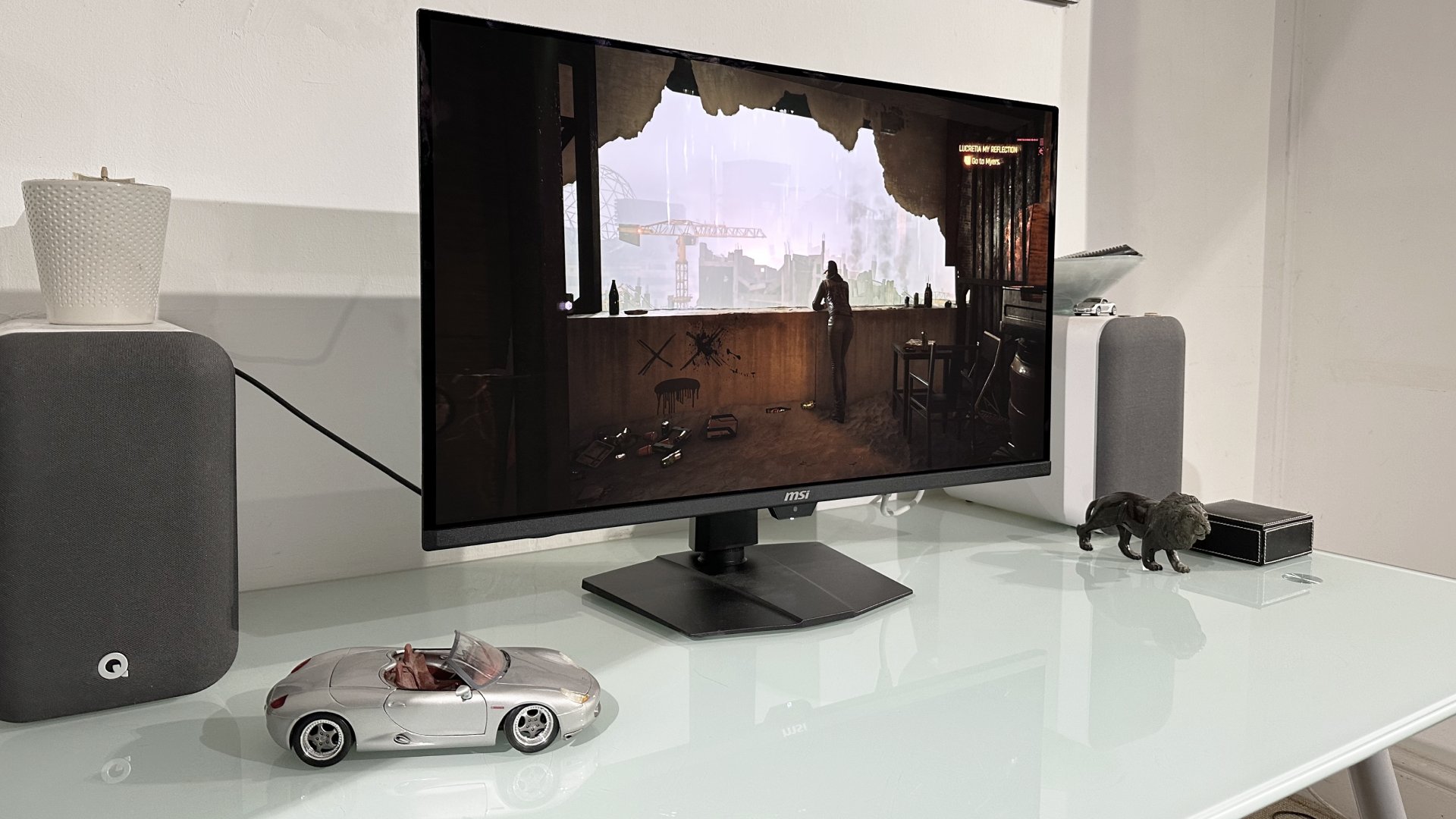
You can already buy 32-inch 4K Samsung QD-OLED based monitors, including the MSI MPG 322UR X24 I reviewed recently, that offer brighter True Black 500 certification. And Samsung has announced yet another 32-inch 4K panel with True Black 600 certification, 360 Hz refresh and RGB-stripe subpixels for later this year.
That latter panel in particular makes the new LG WOLED in the Asus ROG Swift PG32UCWM look a bit behind the curve, even as it launches. It’ll do 350 nits full screen and 1,500 peak HDR.
The LG WOLED in the Asus, meanwhile, tops out at 1,000 nits peak HDR. Asus hasn’t quoted as fullscreen figure. But it will likely be in the 250 to 275 nits range. These brightness figures are despite the panel using LG’s latest Tandem OLED tech. And that’s likely because of the removal of the white subpixel, which LG has thus far used to increase the brightness rating of its OLEDs.
Still, the good news here is that OLED technology is really kicking on this year. We’re getting brighter panels seemingly by the week and RGB-stripe is being ever more widely adopted.
I wouldn’t be surprised if most OLED gaming monitors are RGB-stripe by this time next year. Add in increased brightness and we’re surely approaching a situation where the art of OLED gaming monitors is pretty much perfected.
Well, maybe with one final caveat around burn-in remaining. But the evidence continues to mount around existing panels that burn-in isn’t a massive issue. And these newer panels are meant to be yet more robust.
feedzy_import_tag feedzy_import_tag
About the Author


