Star Wars has been inspiring video games practically since video games have existed, but unlike the trailblazing film series, it has mostly been content to follow the leader. As a result, we’ve gotten all sorts of Star Wars video games molded after familiar templates, from first-person shooters to racing games. Those have been enjoyable enough, but they’re very much defined as: “genre, but Star Wars.” It’s rare, but not unheard of, for a Star Wars game to push a genre forward with a combination of new ideas and great execution. Star Wars Zero Company is one such case.
At first glance, it’s easy to underestimate Zero Company, though. By all appearances this is simply XCOM, set in the world of Star Wars. You have a similar overhead perspective, commanding a small squad of commandos in turn-based combat as they take cover, flank and maneuver, and work together to take down formidable armies. And while that isn’t inaccurate as shorthand, it would also sell the game short. Partly by capitalizing on the rich world of Star Wars itself, Zero Company finds ways to iterate further on XCOM, rather than merely imitate it.

First, some table-setting. Zero Company is set during the Clone Wars era of Star Wars, the tumultuous time seen in the prequel trilogy when the Republic was just on the verge of collapse into the Galactic Empire. Your player character, Hawks, is a down-and-out former Republic commander who started their own mercenary outfit after a disastrous mission gone wrong ruined their military career. The mercenaries, called Zero Company, are having money problems and struggling to find work, when a young Republic officer named Bennic offers steady, not-technically-Republic wet work in exchange for settling your debts.
It would be easy to make Bennic sinister or conniving, dangling cash to desperate mercs, but this is one area where Zero Company excels. The characters are well-rounded and feel alive with humanity. Bennic is actually an honest broker for the Republic–a true believer who quickly folds himself into Zero Company and acts as the Republic’s emissary. At first he seems like an assigned babysitter, but the friendship between Bennic and Hawks grows and changes in believable ways. The same could be said for the other members of Zero Company, like the decommissioned clone Trick or the grizzled old boxer Kabb Uppercut.
The one slight exception is Cly, a Mandalorian bounty hunter who presents herself out of the blue to Zero Company as an asset they can’t afford to refuse. Her story is the thinnest of all the named characters, and while it ultimately gets mildly more interesting, her inclusion felt perfunctory. Mandalorians are a popular piece of the Star Wars franchise, and her power set makes her a great inclusion to the tactical combat, so it makes sense to represent the Mando clan. I just wish her individual story and characterization were as strong as the rest.

As the adventure progresses, Zero Company finds itself facing a crisis flying just below the Republic’s radar–a strange cult called the Coil that inducts new members with superhuman abilities, all rallied under the banner of a leader named Fathom. Bennic helps the team prioritize this threat, which feels appropriately sized for this story. In this era of Star Wars, the threat needs to be small enough that it doesn’t attract much attention from the Jedi or the Grand Army of the Republic, but frightening enough that it could snowball if it isn’t contained. Zero Company is punching above its weight taking on a galactic threat like this, and that gives the story real stakes while still retaining a sense of belonging in the Star Wars universe.
For me, the named characters were the stars of Zero Company, and I used them almost exclusively. Like an XCOM game, though, you can also recruit randomized soldiers to your army and develop them on their own, modeling them after your friends or your favorite Star Wars OCs. And as the story develops, you slowly open new options for the types of operators you can recruit, eventually gaining the ability to recruit droids and clones, which have their own specializations. Those specializations, and especially the ones for the named Zero Company characters, are really the secret sauce that makes Zero Company stand out from other tactics games.
As it happens, Star Wars is an especially fertile ground to have lots of differentiated power sets, so you aren’t just limited to the usual archetypes like soldiers, heavies, and medics. By the time you finish Zero Company, you’ll have access to clones, droids, a Mandalorian, a Jedi, an Umbaran, and whatever the heck a Kabb is. Each of them has their own attributes and most have abilities that are specially tailored to their unique identity in Star Wars lore.

Take Cly, for example. She has the Mando’s signature jet pack, making her an especially nimble operator who can cross great distances easily and ignore many height restrictions. If she lands in the middle of a set of enemies, she’ll even knock them back and inflict burn damage, and by default her weapon is a pistol with three shots. It just feels so perfectly Mandalorian to rocket-drop into a scrum of weakened enemies and pick them all off with three quick blaster bolts.
Your Jedi, meanwhile, excels at up-close melee combat, dealing heavy damage with her lightsaber, pushing and pulling enemies with the Force, and then dropping into a defensive stance that blocks many blaster bolts. And true to their Star Wars identity, droids are an incredibly useful support tool, able to grant your teammates extra moves and carry more equipment than anyone else. They’re all so fun to play with. I often wished the squads were bigger so I could bring more of them along on missions, and picking and choosing which ones to make my core crew was difficult.
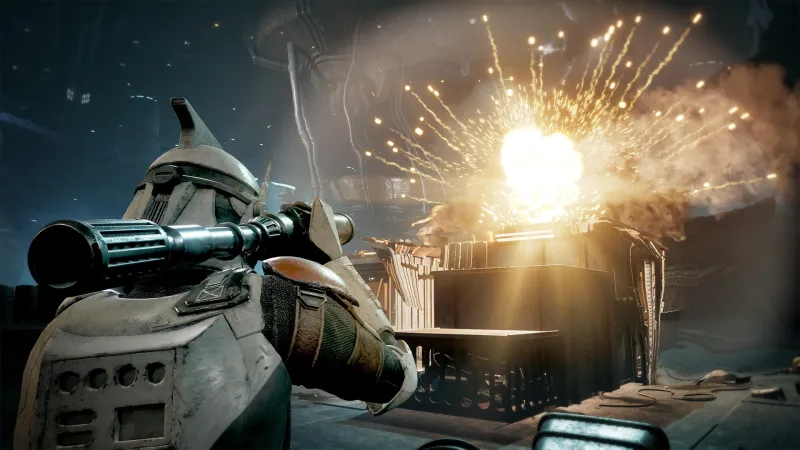
Most of these abilities cost Action Points–three per character, per turn–which are well-tuned to balance your movement and attack abilities. My Hawks was a sniper, for instance, so I quickly had to internalize that since her main attack cost 2 AP, her movement was severely limited compared to the rest. She had just enough to reposition slightly, but couldn’t move across the map like the others. And if I were already in an advantageous position, I could fire off a shot and then use her extra-long Overwatch ability to restrict enemy movement. Jae or Cly, meanwhile, could move much more effectively, but were much less accurate and powerful. Successful actions also build up a shared pool of Advantage (ADV), which enables extra-powerful moves like Trick’s Rocket Strike, which does a ton of explosive damage in a concentrated location. I got in the habit of saving that little beauty for when enemy reinforcements showed up and crowded around an entry point. But ADV also has a lot of utility for giving you occasional access to moves with specialized use-cases, like Cly’s aforementioned jetpack.

Each combat encounter also has a rotating backup ability, which alternates between the members of your squad randomly each turn. Selecting your backup before starting your attack action will let another member of the squad take a shot too, doubling your effectiveness. But that also means you need to carefully position your squadmates and consider which ones have a clear line of sight before you choose a backup partner, adding another tactical wrinkle to combat. And it awards Bond XP between operators as well–more on that in a bit.
You use these abilities on a wide range of enemies, from regular humanoids to Clone Wars-era battle droids, including deadly droidekas, to the cultist Coil. The Coil is not quite a hivemind, since it doesn’t have one shared consciousness. Instead, its fanatical followers all work individually but collaboratively toward a goal in perfect unison. (If you’ve seen the Apple TV show Pluribus, you’ll have the general idea.) It’s unnerving from a story standpoint and has neat applications in gameplay. Since the Coil are all linked, defeating one will often empower the next-closest Coil member with some special ability like extra defense or even cloaking. That adds yet another dynamic element, forcing you to carefully plan which ones to pick off and in which order to maximize your advantage over the rest, knowing that they’ll be steadily ramping up in difficulty as you do.
And those Coil advantages are partially influenced by the mission briefs, where you’ll sometimes be given a choice of which Coil upgrade to stop. There’s no way to prevent both–the Coil abilities will get stronger in some way no matter what–but these decisions let you shape the types of challenges you’ll face in the tactical missions. Your home base is where you’ll spend mission cash on upgrades that apply to your whole team and black-market gear for your individual units. You’ll also be able to upgrade your team’s bonds, which start to unlock powerful upgrades across both operators when they reach the highest levels, manage their ability loadouts with unlimited free refunds to toy with different builds, adjust equipment and weapon mods, and more.

If that description hasn’t made it clear, there are choices upon choices upon choices in Zero Company, but it never feels overwhelming or obtuse. Everything is digestible and clear, which is quite a feat for such a dense tactical game with so many options. I always felt fully in control of my decisions and knew exactly what I was doing.
While there was a great variety of abilities, enemies, and satisfying tactical choices, though, some of the missions did start to feel very familiar over my 30-hour playtime. I attribute this to similar objectives, which made many missions play very similarly. You often have to wipe the battlefield of all enemies, of course, but missions would often then end with getting to an extraction point, usually after a dose of reinforcements. The tactical combat itself is very fun, so it didn’t bother me too much, but the lack of variety in mission objectives stood out as a weak spot.
While Zero Company uses cameos sparingly, the ones it does include are effective. Anakin Skywalker shows up briefly, so you can be completely overpowered for a handful of missions, and in the context of the Clone Wars cartoon, this is believably just another mission he was tangentially attached to for a little while before jetting off to other Jedi missions. I wasn’t too sorry to see him go, because by that point I was developing such affection for my squad that I wanted to spend more time with them anyway. That’s what makes the story so effective. The story of the Coil cult is a somewhat typical sci-fi threat, but I wanted to overcome it with my squad, as I had shaped and gotten to know them. We built bonds as a game mechanic, but I built bonds with them myself too.
Star Wars Zero Company is like XCOM, but it is more than just an XCOM-like. Developer Bit Reactor set higher ambitions than simply slapping a Star Wars skin on a template. Star Wars is a rich playground for games, with loads of differentiated hero and enemy types and powers baked in, and Zero Company takes full advantage of that to make an excellent tactics game in its own right. In doing so, it has made the next great evolution of the genre.
feedzy_import_tag
About the Author