Perhaps because he’s so cute and marketable, Yoshi’s adventures have been designed for a younger and younger audience for the last several years. 2006’s Yoshi’s Island DS was not out-of-step with the difficulty of a mainline Mario game, but since then, the challenge of mainline Yoshi games has been slowly softened to target younger audiences. With Yoshi and the Mysterious Book, Nintendo has made the gameplay even more gentle for gaming novices–but what it lacks in difficulty, it mostly makes up for in creativity and a playful gimmick built around discovery and exploration.
Yoshi and the Mysterious Book isn’t a typical platformer. You don’t move left to right to reach a finish line, Yoshi can’t die, and there aren’t enemies to overcome in a traditional sense. Instead, the stages are little biospheres teeming with natural flora and fauna. Rather than fight them, you’re there to study and document them–Yoshi is less of an adventurer this time around, and more of a research assistant.
You’re conducting research inside the pages of Mister Encyclopedia, aka Mr. E, a conscious compendium of all life on a remote, unnamed island. The Yoshis volunteer to jump into the pages of the book and document their findings, putting each of the creatures there through their paces. That usually includes documenting how they taste, what happens if you throw them, how they interact with their environment, and even how they interact with each other. This transforms stages into little standalone playgrounds where you experiment with a new creature and see what it can do. The play is about the discovery itself, as you observe different reactions and the game gently guides you to try new things.
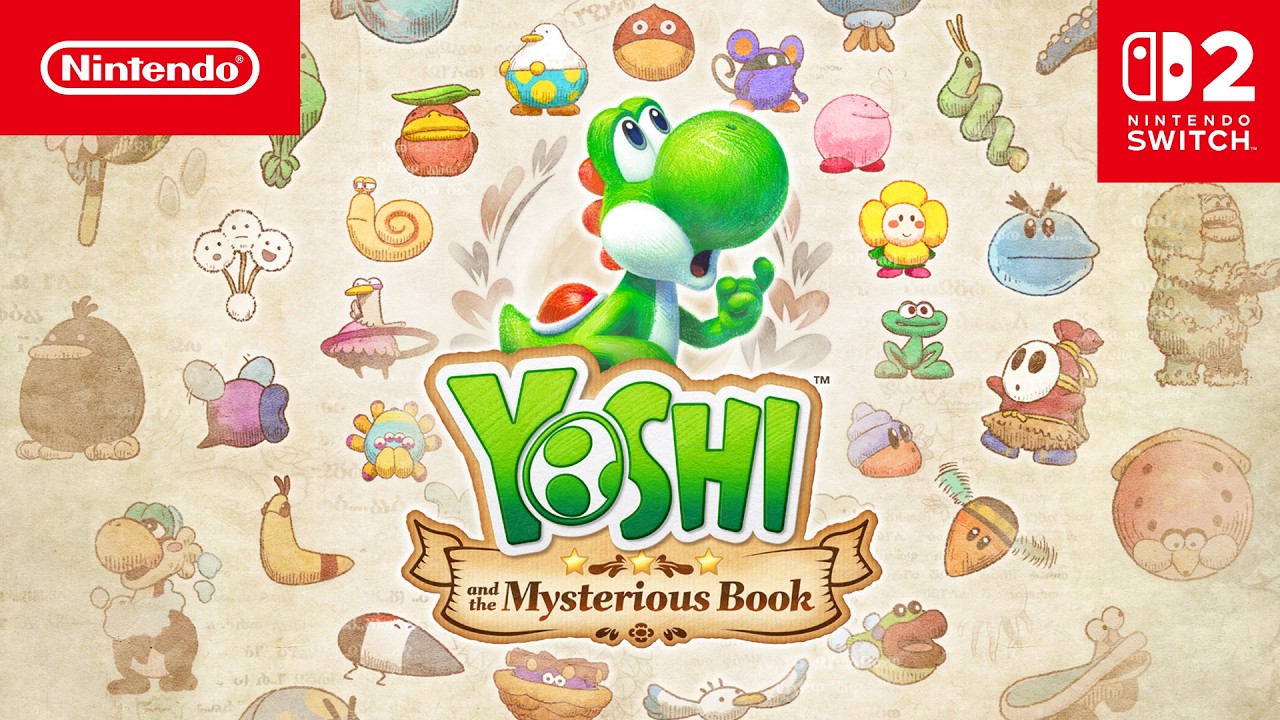
It’s surprising how well this works. Instead of reaching a goal line, the stages conclude when you make some pre-defined, especially significant discovery. For a set of flowers called Crazee Dayzees, for example, it’s using them to grow large flower buds. For Shy Guys, it’s finding all of their hiding spots. For Casterway, a creature with a fishing pole, it’s catching a huge lunker of a fish lurking in the water below. I wasn’t sure how well the game would approach guiding you towards your goals when no two goals are exactly the same, but it works remarkably well. You can always ask Mr. E for a hint, but I rarely needed to. The rhythms of the stages and cascading discoveries often just led me to the right conclusion.
Years of Mario platformers, of which Yoshi owes its lineage, makes the general controls feel natural and fluid. You can run, jump, swallow things with your sticky tongue, and throw eggs using the left stick for aiming. But Yoshi and the Mysterious Book also gets a delightful amount of variety out of both its differentiated goals, and its myriad strange creatures. A Snurfboard creature functions like a surfboard, letting you ride on it and do tricks. Meanwhile, a Slugarang, a bug shaped like a boomerang, lets you toss it away as a projectile to mow down grass and trim trees, allowing you to make new discoveries. Each world has at least one creature like these two examples, and their inclusion mixes up the gameplay in some new and surprising way, which helps maintain a brisk pace of variety. And as you get deeper into the game, you start to find creatures that interact with other, earlier ones you had already discovered. You can go back and spend coins to buy hints for interactions you may have missed in a previous area if you want to see them all.
I should say here, by the way, that each of these creatures can be named however you wish. You’re the archeologist discovering them, so Mr. E lets you name them. I didn’t use this functionality much, preferring to hear their canonical names per Mr. E’s suggestion, but it’s a cute touch that I’m sure kids will enjoy.
The story is light to the point of being almost non-existent. Somehow, Bowser Jr. and Kamek have found themselves in the titular book as well and they’re searching for a rare species. You restore the pages of the book to unlock new areas, and naturally that means you’re on their trail, but you aren’t given any particular motivation otherwise.
That said, the main story culminates in a plot twist, of sorts, that is so bizarre and left-field that you really need to see it to believe it. The story was too bare-bones to evoke a strong emotional reaction from me, but I was still amused that such a cute game had such a dark idea lurking inside it.
Speaking of seeing and believing, the visual style in Mysterious Book is gorgeous. Inside the book, the whole game has a visual layer that makes it look like illustrations on a page, with a colored pencil aesthetic and skipped frames to accent the effect. Especially when played in TV mode, Yoshi is full of expressive reactions to everything he sees, and in particular, everything he tastes. These playful cartoon expressions help to even further accentuate its appeal for younger players.
This clear targeting of younger gamers has its drawbacks, though. Most notably, while this is a game that seems aimed at early- or pre-readers, it’s absolutely chock full of text to read, and there is no voice acting or spoken dialogue to make the experience more accessible to the audience that will likely be enjoying this game most. Mr. E speaks in simlish-like vocalizing but the dialogue has to be read. Discoveries pop up as text as well. The hint system is all text too. A younger player without strong reading skills might be able to play with the systems and make discoveries, but it may be hard for them to progress without someone around to interpret the text for them.


For older players, there is a little more complexity hidden behind the first ending. It’s actually one of the coolest features the game has to offer, which makes it strange to rope it behind game completion. Once you finish the main story you open up a modular UI, with “Exploration Tools” that can be bought in exchange for the Smiley Flowers you’ve been gathering throughout the journey and then mapped to a grid overlay. These tools are unlocked in a particular order so you can’t select which ones you want, but a few of them include a Bioscanner to track nearby creatures, thermometers to track temperature, and more. There’s even a lifebar for Yoshi, which confusingly doesn’t seem to do anything since you can’t die–but when Yoshi gets low enough in health he visibly reacts. Presumably this system was running under the hood the whole time but I never even noticed until unlocking the tool.
Those tools can be applied to extra biomes that open up after the first ending as well. That extends the adventure into new areas with new creatures, as well as allowing you to discover how those creatures and your new Exploration Tools interact with all the ones you’ve already found.
How much mileage you get out of those extra stages, and in fact out of the entire game, relies largely on your level of curiosity. Yoshi and the Mysterious Book is fundamentally a game about poking and prodding at the world and seeing what happens. It won’t test your precision platforming skills, but it serves as a gentle introduction for novices, and an experiment for even experienced gamers to see an audacious, expanded idea of what a platformer can be.
feedzy_import_tag
About the Author