Imagine a Lego set that represents Batman 89, the Tim Burton classic that helped create the modern superhero blockbuster. Then imagine other sets that represent Batman Returns, Batman Begins, The Batman, and so on. You start breaking pieces apart from each set and piecing them back together. At first you can identify a chunk from one movie and distinguish it from another, but the more you mix, the more unrecognizable they become. Before long it’s difficult to tell exactly where one begins and another ends. That’s what it feels like to play Lego Batman: Legacy of the Dark Knight, a game that litters its influences so liberally that the pastiche becomes its own reality. In the process, it recaptures the glory days of licensed Lego games by feeling, for the first time in a long time, fresh.
The freshness is what I kept coming back to throughout my time with Legacy of the Dark Knight. Like lots of people, I played Lego Star Wars: The Video Game, the 2005 Traveller’s Tales game that established a house style for Lego games and began a flurry of licensed tie-ins. I loved it, and I spent countless hours plumbing its depths and unlocking every character. It was a simple game bursting with secrets to find as well as a playful take on a mythology that mattered to me.
Since then, though, the franchisification of licensed Lego became supercharged, to its detriment. At the height of its power there would be three or even four licensed Lego games released in a single year, and the series burned itself out. You can only find hidden doodads so many times. In recent years, Lego has seemed more cautious, producing more artsy takes like Lego Builder’s Journey or Lego Voyagers, with far fewer licensed games. Against that backdrop, Lego Batman: Legacy of the Dark Knight feels like a statement of intent. With additional care and time, this is what a Lego game can be.
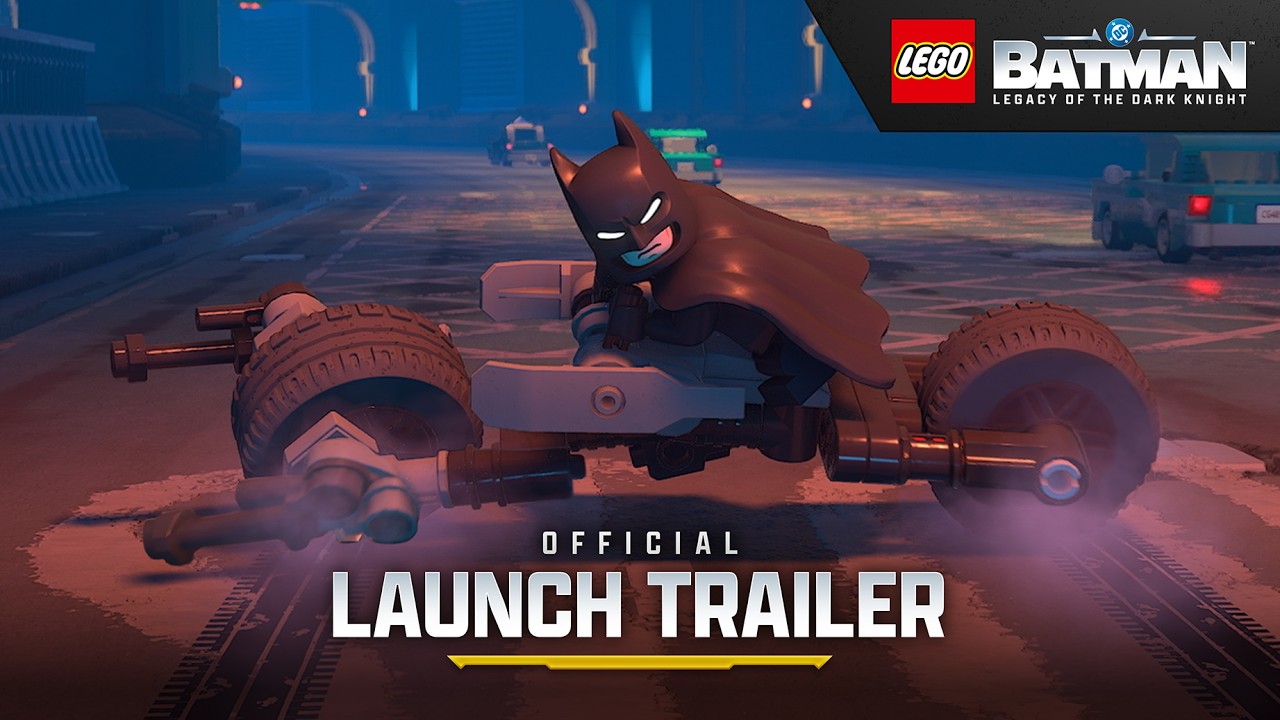
Legacy of the Dark Knight tells an original story, kind of, cobbled together and reassembled from the stories of various other Batman media. Most often these are pulled directly from the myriad movie adaptations and reboots, but it’s also informed by stray influences from well-known comic arcs and at least one very notable video game influence. And since characters have crossed multiple movie adaptations and interpretations, there’s some loose justifications put in to explain how the characters change over time. Jack Napier starts as a member of a regular gang, before donning the Red Hood and falling into a vat of chemicals, but he was always a sadist who liked to taunt his victims, and in this telling he even had the plan to poison people with Smilex before he succumbed to its effects himself. The Penguin is a low-level thug a la The Batman universe before he transitions to a mayoral candidate with animalistic habits as seen in Batman Returns. There are lots of other surprising developments that I’ll let you discover on your own.
By imitating and remixing so many classic movie moments, though, it does invite direct comparisons to the originals. It’s simply strange to hear iconic moments with new voices. Jack Nicholson’s lines as the Joker are especially seared into my mind, so it sounds just slightly off to hear him imitated by a voice that is meant to be a broader take on the character, to facilitate his various transformations. It feels unfair to lay that at the feet of the actor, who does a fine job with the material, but telling any actor to do an exact re-take of some of the most famous lines in superhero cinema history is a rough assignment. Similarly, the story can sometimes feel a little shaggy, briskly connecting two movie plots that weren’t ever meant to connect. Usually this is played for laughs, so it works well enough since it gives the impression that the writing is in on the joke.
Through all of these vignettes, the story mostly focuses on building the Bat-family, suggesting that’s really the most important part of his legacy. Each chapter focuses primarily on befriending a new crime-fighter like Robin or Batgirl and learning their unique mechanics for battles and puzzle-solving. You’re always playing as Batman alongside one ally, though your secondary character can be switched at will most of the time. This focus keeps the characters selection relatively small, a marked change from the sprawling roster in most Lego games that has led to sorting them into character types. Jim Gordon has a pair of special guns–one that fires sticky goo and another that fires a ricochet bulb–and he’s the only one with that particular set of skills. Batgirl is the only one who can hack computers, Robin can pry open cracks with his bo staff, and so on.

Lego games are always collect-a-thons, and this one is no exception. But rather than a humongous roster, you’re collecting currency to unlock new looks for your core crew, color modifiers that can be applied to any outfit, upgrade material, and trophies for your headquarters. It all feeds into itself very nicely, and I would often make a point of visiting the in-game shop to unlock new costumes. As both a Batman and Lego fan, it’s just endlessly cool to see how different suits have been visualized in this style, and there are tons of extremely specific references to particular comic arcs alongside suits representing every movie and TV adaptation you can think of. I never cared much about unlocking every Droid in a Lego Star Wars game, but I want to see every single deep-cut Bat-suit this game has to offer.
Legacy of the Dark Knight also pays homage to Rocksteady’s Arkham universe, most notably as the foundation of its gameplay. The rightly praised Arkham combat makes a return here, with the same basic cadence of punches, dodges, and parries, augmented with gadgets as you upgrade your gear. It’s a little slower-paced, but as the enemy count and combo meter increases it almost feels like an Arkham game with a Lego visual overhaul mod. It lacks some of the brutality and precision of the Arkham games, especially with more limited gear and gadget upgrades, but it very accurately recaptures the spirit of Arkham’s rhythmic combat style.
I don’t want to oversell the Arkham connections, because the combat in Lego Batman doesn’t reach that level of finesse. This is more Arkham Lite than a true successor to the Rocksteady games. However, the injection of even just some Arkham DNA does make combat much more satisfying than it has been in traditional Lego games, showing that even a little bit of that secret sauce goes a long way toward making a game feel more engaging.
Similarly, traversal throughout the open world of Gotham feels almost a match for the traditional Arkham games. You have access anytime to your choice of Batmobile from across the spectrum of Batman’s iconic car. For the most part these feel very similar, with the ability to quickly accelerate across straightaways as well as navigate hairpin turns. They do differ where it makes sense, though. The Tumbler from the Nolan movies feels much heavier and tank-like compared to the light and nimble Batman 89 version, for example. Most of the time, though, it’s quicker and easier to simply grapple up to the nearest, highest point and leap, using your natural glide to cover long distances. Again, this doesn’t quite match the balletic grace of the Arkham games, but it’s remarkably close.

The one spot where the Arkham comparisons fall short, though, is the stealth. The Arkham games were notable for living the fantasy of Batman, turning you into the predator and criminals–a cowardly and superstitious lot–into the prey. Stealth in Legacy of the Dark Knight is passable but unremarkable. You can sneak up on enemies for an instant takedown, but you have fewer tools to inspire fear in a room full of enemies or disappear if you’re spotted. Instead of clearing a full room, I would often take out a couple enemies, get spotted, and finish off the rest with traditional combat. It’s an unfortunate weak spot in a game that is otherwise extremely effective at emulating what are widely regarded as the best Batman games.
And within those strong underpinnings, Legacy of the Dark Knight thrives on variety without feeling bloated or overstuffed with half-baked characters and mechanics. The open world of Gotham has tons of caches to find, Riddler and Cluemaster puzzle challenges, AR combat and racing challenges, crimes to stop, and even short environmental puzzles to unlock fast-travel points. Even within an individual mission you’re never doing one thing for too long, as you’ll transition from combat to puzzle to platforming challenge and back again. The story campaign itself moves at a brisk pace with lots to do, but you can also just get lost in Gotham finding things to unlock and empower your Bat-family.
With so many options at my fingertips between multiple allies, I appreciated the addition of a sonar ping similar to Arkham’s Detective Vision that would highlight objects of interest. Sometimes this would be necessary to scan a clue or follow footprints, but you can also use it to show the way forward. I have felt incredibly stupid at times playing past Lego games, knowing that I’m overlooking something obvious that’s gating my progress forward. I never struggled with that in Lego Batman: Legacy of the Dark Knight, because the ping system was always there to highlight objects of interest. Most of the level gating involves breaking apart certain objects and then building them into some prop to move forward, so in a pinch this helped me identify which objects to break or even which ones were breakable.
Adding another wrinkle of strategy is a stud-multiplier system that, if it has been in other Lego games, it must have been one that passed me by. Other Lego games have featured multipliers as unlockable bonuses, but in Legacy of the Dark Knight, it’s a meter you build that then slowly drains. This actually adds a layer of decision-making to your wanton destruction, since it’s best to build up a multiplier before going after a particularly high-value stud. It’s just another way this game adds a tiny bit of extra depth–not enough to be overwhelming or feel out of place in a Lego game, but enough to keep it engaging for adults.
And on that note, this is certainly a game aimed at adult Batman fans who are familiar with the character’s rich history in cinema. Batman himself is portrayed with his trademark stoicism, but he’s also a puckish, Bugs Bunny-style mischief maker. Nested within the reference-laiden story are individual references to influences as diverse as It’s Always Sunny in Philadelphia and Street Fighter 2. The writing is sharp and frequently laugh-out-loud funny. This game in particular shows off a knack for timing and sight gags with cinematic flair.

Silly as it often is, this is a game that makes a point to show the passage of time. Bruce gets visibly older as the story proceeds and enters different phases of his life and his relationships with his allies. The iconic Bat Cave itself slowly develops from a natural rock formation with a handful of computer consoles to a sprawling technological marvel that documents your accomplishments and unlocks and allows you to customize many parts of it to your liking.
In a larger sense, Lego Batman: Legacy of the Dark Knight is fundamentally about time and the changes that come with it. It’s been more than 20 years since Lego games hit it big with Lego Star Wars, and for a while, it felt like it had lost its way and become a whirring franchise-printing machine. Legacy of the Dark Knight rights the ship by getting back to fundamentals with deeper focus, razor-sharp writing, and just the right amount of mechanical complexity. For the first time in a long time, this is a return to form for the Lego series. It’s still simple, but not quite as simple, it’s bursting with even more secrets, and it’s another playful take on a mythology that I love. It’s the most fun I’ve had with a Lego game since 2005, and a template for how Lego games can rebuild into something greater, piece by piece.
feedzy_import_tag
About the Author