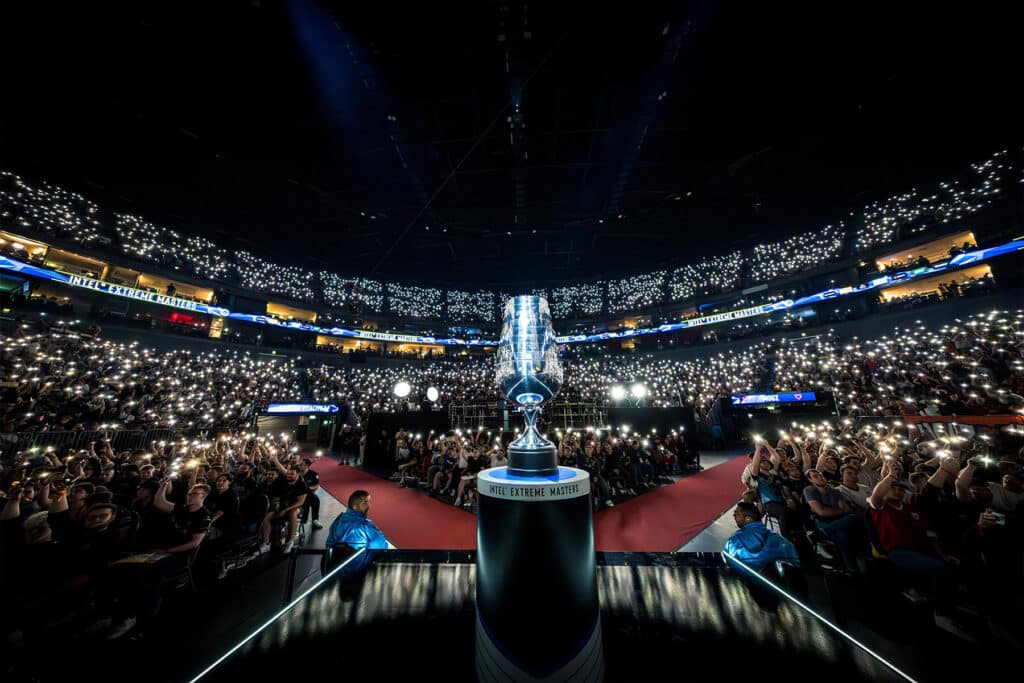
The IEM Cologne Major is set to be one of the biggest Counter-Strike 2 events of the year. Starting on June 2nd, it will take place at the LANXESS Arena in Germany and feature a $1.25 million prize pool.
This puts it in the top 10 Counter-Strike 2 tournaments by prize pool. But there may be a bigger source of income for participating teams.
Esports Needs to Copy IEM Cologne Major’s Sticker Revenue-Sharing System
IEM Cologne is a massive tournament spanning three weeks. Stage 1 runs from June 2nd to June 5th, with the eight qualifying teams advancing to Stage 2. They join eight directly seeded teams in two groups of eight, competing from June 6th to June 9th. Stage 3 turns to best-of-three matches, with the top eight teams advancing to a single-elimination bracket.
These eight teams will join directly seeded teams: Team Vitality, FURIA, Natus Vincere, FURIA, Falcons, MOUZ, Aurora, The MongolZ, and PARIVISION.
The team that places first will get $500,000 of the prize pool. The runner-up team gets $170,000. Third and fourth-place teams get $80,000. Teams that place fifth through eighth get $45,000.
However, that’s not the only way teams make money at IEM Cologne. The event will run Valve’s new sticker revenue-sharing system. Sticker capsules will be sold over the tournament’s three weeks, allowing players to support their favorite teams in-game.
StarLadder Major Berlin saw $11 million in sticker sales revenue in 2019, proving it to be a lucrative endeavor for qualifying teams. PGL Stockholm and Antwerp collected $70 million combined. Last year’s BLAST.tv Paris Major allegedly made $110 million, not even including Vitality’s Champions capsule. Given how sticker sales revenue was split, each Contenders team received $4.5 million plus $250,000 per player, Legends earned $3.5 million per team and $200,000 per player, and Challengers got $2.6 million per team and $200,000 per player.
For the IEM Cologne Major, the sticker revenue model has some big changes. Tournament organizers now retain 5% of the 50% pool, previously reserved for organizations. The remaining 45% is shared among teams, split based on their Valve Regional Standings positions. The highest-ranked team gets 2.85%.
This still allows lower-ranked teams to see a fair amount of money. Why is that important? Because you need these newer and smaller teams to remain active in the esports scene. More often than not, teams that aren’t considered the biggest in the world don’t earn enough prize or sponsorship money to thrive, removing many teams from the ecosystem.
This has been a huge topic of discussion in the esports industry, with FlyQuest even promising to donate to underrepresented teams and esports scenes that need funding earlier this year. Other scenes have felt the pressure, with the high salaries of Dota 2’s best players draining the scene dry.
Counter-Strike has often been respected for its support of smaller teams and Tier 2 tournaments. Having money for participating teams beyond the prize pool encourages teams to invest in their players and inspires those players to push themselves to qualify. You’ll get all-around better tournaments and a lot more talented teams in the mix.
Instead of franchise leagues that cater to teams that paid to participate and leave others out of the tournament and without support, Counter-Strike’s esports scene has the mentality that anyone should be allowed to qualify for a major if they’re good enough.
Said one fan on Reddit: “The longevity of the Tier 2-3 scene is primarily driven by the decentralized tournament circuit and the high volume of liquidity from skin markets. Unlike franchised leagues, this open ecosystem allows smaller orgs to maintain operations through niche sponsorships and regional betting partnerships.”

This is definitely something the esports scene needs right now as the hype starts to die down and the money fizzles out.
The post IEM Cologne Major has massive $1.25 million prize pool, but the real money lies elsewhere appeared first on Esports Insider.
feedzy_import_tag feedzy_import_tag
About the Author


