TL;DR
- Deadlock no longer has a separate ranked mode, but still uses MMR-based matchmaking with rank badges that update in real time.
- Players have both core MMR and hero-specific MMR, with matchmaking taking into account both.
- There are 11 rank tiers, each with subdivisions, plus leaderboards for top players by region and hero.
Valve’s upcoming hero shooter and MOBA hybrid, Deadlock, is a feast for competitive players. It has everything from skill expression and playing the map to in-depth itemisation to showcase your mastery of the game. There’s a wide gap between players who are deep into the game’s mechanics and those who are still learning the ropes.
While Deadlock doesn’t have a separate ranked mode for now, it does its best to have fair matchmaking with its ranked system. Let’s dive into how this system works, how your rank is determined, and what this means for players who want to climb up to the big leagues.
What happened to Deadlock’s ranked mode?
New players learning Deadlock wouldn’t know that the game had a dedicated ranked system during early playtesting. Although the game has removed the featured queue, the post is the last official communication on how ranked was calculated. We assume Valve still uses the same or similar logic to determine your individual rank.

Deadlock’s ranked mode was first implemented on October 10, 2024. At the time, there were only specific time windows when the mode was available to keep competitive players concentrated in one mode.
Players who were involved in the playtesting back then needed to complete 50 standard games to qualify. Additionally, it also prevented players with behaviour-related restrictions, such as voice and text bans, from joining the queue.
When in this mode, you will only be matched with players who have the same medal as you. There are 11 medals in total, each with six levels. Everyone’s medals and levels will be displayed in these ranked games.
Valve has stated that they use an algorithm that calculates everyone’s performance at the same time based on the games you’ve played, how the opponents you played ended up performing in their next games, and more.
So, rather than updating your rank per match based on a win or loss, every player’s rank was calculated at the same time and recalibrated together. Players also needed to play at least seven games during the week to be eligible for a rank the following week.
Deadlock’s ranking system explained
Valve reworked its matchmaking on November 21, 2024, and still uses the system in 2026. The biggest change during this update was removing the dedicated ranked mode. This funnels the playerbase into one primary matchmaking mode and helps Valve collect data for its playtest.
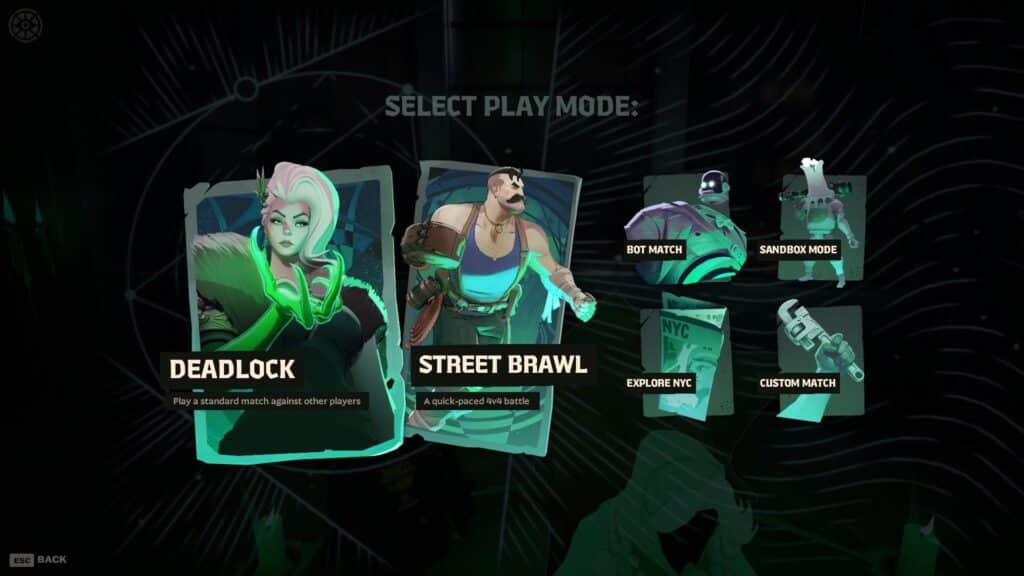
Deadlock’s ranked system evolved to become responsive by removing the weekly badge updates. Now, your rank badge updates immediately when your Matchmaking Rating (MMR) crosses the threshold for a higher or lower rank. Valve also regularly adjusts the global curve based on factors such as the number of players, banned players, and other recalculations it deems necessary.
Alongside your core MMR, Valve has also implemented a hero-specific one, based on the most recent 20 matches played with each hero. Basically, if you’re queuing with a hero you have less time in or they’re not the best in your roster, you’ll be put into an easier lobby.
Valve takes this a step further by allowing players to track their progress on regional leaderboards. Every region (North America, South America, Europe, Asia, and Oceania) has two leaderboards: one for the top 1,000 core MMR players and one for each hero’s top 1,000 hero-specific MMR players.
But first, you’ll need to have 50 games played in the last 30 days to be qualified for leaderboards. For the hero-specific category, you’ll need to have at least 20 games on that hero in the past 30 days.
If you want to keep a better track of your MMR, go to settings, then game, and there should be options for Matchmaking. There, enable rating change notifications and post-match team ratings to see the change to your MMR and everyone else’s ratings in the lobby.
Other factors that affect Deadlock’s MMR
As Valve hasn’t directly communicated how MMR and matchmaking are calculated, we have to rely on the October 2024 post for a rough idea of how it works. However, we do know other factors that affect this hidden magic number.
Players are free to queue up with a party of any size. However, MMR gains are reduced based on how wide the range is in the party. This is most effective when there are relatively new players in the party paired with someone with a higher MMR. Valve will minimise updates to veteran players as the system tries to figure out a fair matchmaking for newcomers.
At high ranks (Ascendant 1 and above), the party size has been increased from two to three. Valve has somewhat loosened its restriction on having too many high MMR players in the same party, which will most likely lead them to stomping their matches.
Another factor that affects Deadlock’s MMR gain is match quality. Outside of peak hours, Valve’s matchmaking is less likely to find a fair match, meaning it will weigh the match less compared to an average match during peak times.
Deadlock: Rank medals and tiers
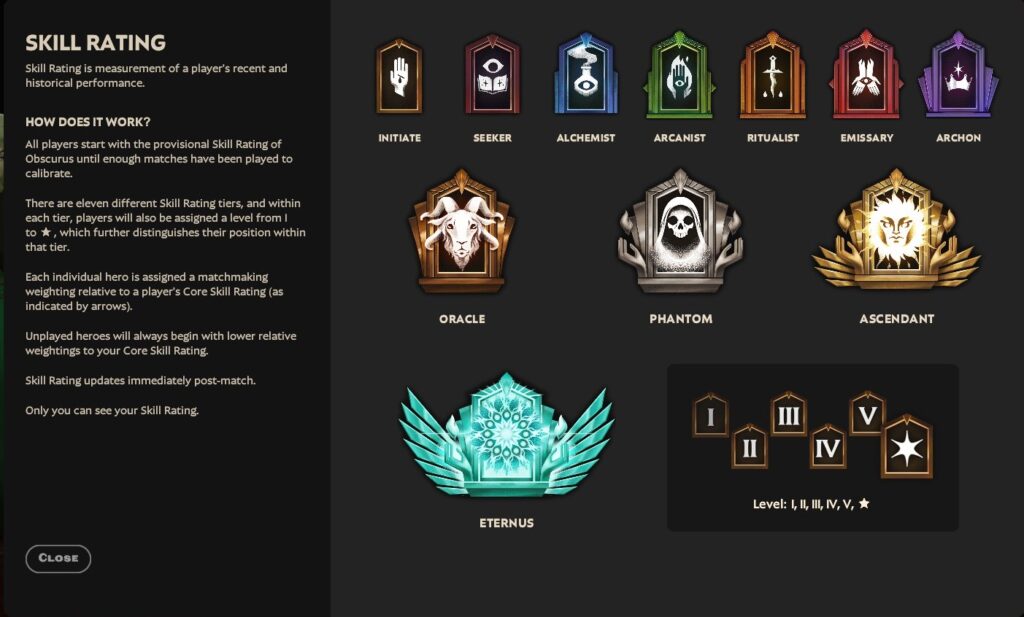
While Deadlock’s MMR is hidden from the public eye, Deadlock’s ranks are a clear indicator of how far you’re up the skill hierarchy. Unlike Overwatch, there isn’t a need to rank up through passing a series; all you’ll need to do is pass the MMR threshold to get higher or lower.
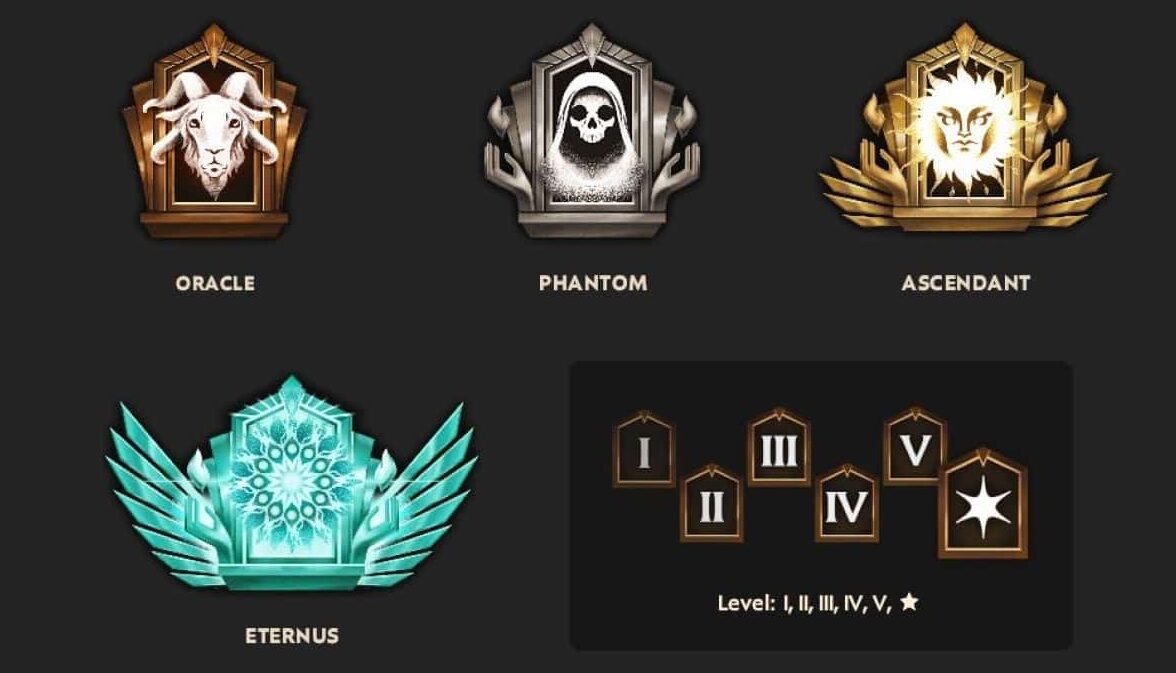
There are 11 skill rating tiers in Deadlock in ascending order:
- Initiate
- Seeker
- Alchemist
- Arcanist
- Ritualist
- Emissary
- Archon
- Oracle
- Phantom
- Ascendant
- Eternus
Additionally, every medal has subdivisions. Players are assigned levels 1 to 5, then finally a star. Players who don’t have enough games will be temporarily placed in a ranked called Obscurus
Ranked match distribution
Deadlock’s rank system is similar to Dota 2, where players’ ranks are shown through badges based on the global MMR thresholds. These badges reflect where a player stands relative to the rest of the ranked population, with higher badges requiring higher placements on the overall MMR curve. Rather than assigning ranks based on fixed point values, Deadlock uses percentile-based thresholds, which means it can shift higher as the player base grows.
While Valve keeps the real values of the MMR to themselves, we can use third-party tracking websites to get a good idea of Deadlock’s ranked curve.
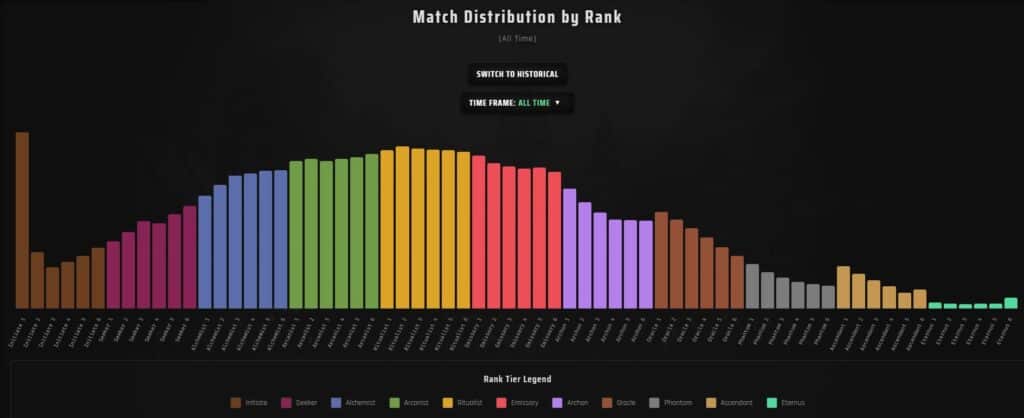
This graph shows the number of matches played by each rank in Deadlock. Based on this, you’re an average player (52-49%) if you’re within Ritualist 2 and 3. Any skill tier above that means that you’re better than the regular Deadlock player globally.
The top 30% of players in Deadlock reside above Emissary 4, the top 20% start from Archon 2, and the top 10% of players are between Oracle 3 and 4.
For the top three ranks, Phantom hosts the top 7-4% players in Deadlock. Ascendant goes from 3.4-1%, while Eternus (0.6% onwards) is where the best players in the world reside.
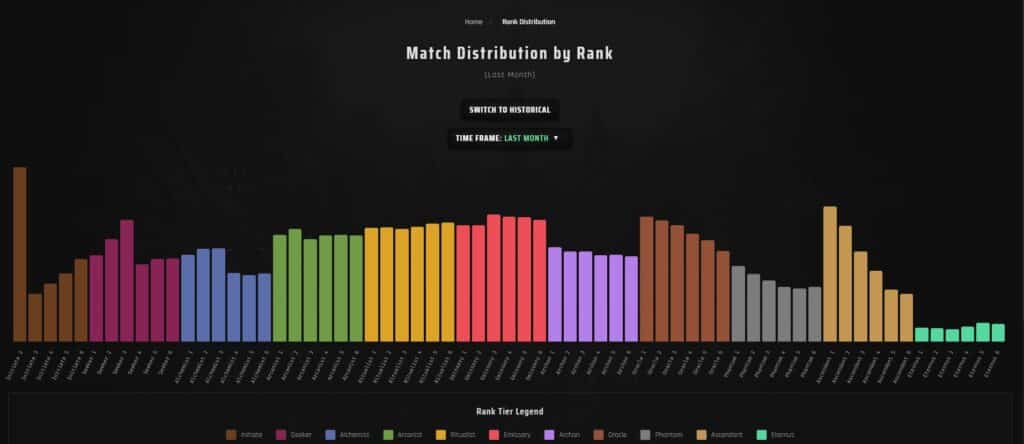
However, sorting by more recent match distribution shows that the curve is rising as new players become better at the game. This also takes into account the rapid influx of new and returning players because of the Old Gods, New Blood update, as well as the introduction of the casual Street Brawl mode.
For example, the top 2% of players in Deadlock are now fighting it out in Eternus. The mean average now lies between Emissary 1 and 2 (51-49%), and the top 10% of players are now all the way up in Ascendant.
Conclusion
Deadlock might not have a dedicated ranked mode in its current state, yet the system is doing its best to get you into fair matches (even if it has the occasional spectacular failure). For the most accurate results, it helps to play solo and consistently with a core roster of heroes, to stay within the expected variance of your skill level.
However, if you’re playing at off hours, with a wide roster, or with a party with a huge gap in skill, Deadlock’s system will place you into lobbies you don’t normally belong to. Either way, remember that the game is still in its playtesting phase, and it’s important to offer feedback to Valve so they can tune out the algorithm’s quirks.
FAQs
How does the Deadlock ranking system work?
Deadlock doesn’t have a separate rank queue and uses one primary matchmaking mode. You’re tracked through a hidden MMR system and visually updated through badge rank. Deadlock uses Core MMR for your overall performance and hero-specific ones to track your performance on every character.
What are all the Deadlock ranks in order?
The 11 ranks in ascending order in Deadlock are Initiate, Seeker, Alchemist, Arcanist, Ritualist, Emissary, Archon, Oracle, Phantom, Ascendant, and Eternus. Each rank also has subdivisions.
How to unlock ranked mode in Deadlock?
Deadlock no longer has a dedicated ranked mode to unlock. All players are placed into the same matchmaking system. But if you want to appear on the leaderboards, you need to have at least 50 matches in the last 30 days.
What is the highest rank in deadlock?
Deadlock’s highest rank is called Eternus, representing the top 1% of the playerbase.
REFERENCES
- 10-10-2024 Update (Deadlock)
- 11-21-2024 Update (Deadlock)
- Deadlock Stats Tracker & Match Analytics (Statlocker)
The post Deadlock ranked explained: How the competitive system works appeared first on Esports Insider.
feedzy_import_tag feedzy_import_tag
About the Author